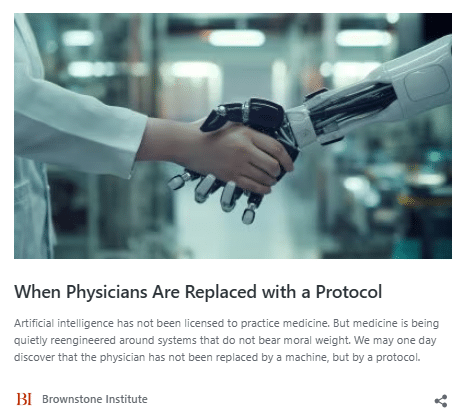
* 🗣️ If an AI‑guided decision harms a patient, who *should* be held responsible—and how do we make that real, not symbolic?

* 🚨 Should regulators require a named clinician to own every AI‑influenced decision, with explicit power to override it?

* 🧪 Are you already seeing “protocol over judgment” in your health system—and is AI accelerating it?
I subjectively want the efficiency, but what about accountability? Have a read. And make sure you run your answer past your personal AI to get approval on what you’re thinking? Just kidding. What are your thoughts?
“Wenn Ärzte durch ein Diagnose- und Behandlungsprotokoll ersetzt werden”
Das haben wir ja schon in gewissem Umfang als Leitlinien. Leitlinien bilden jedoch nur den Konsens der aktuell anerkannten Medizin ab, wobei Krankheiten Fachrichtungen zugeordnet werden.. ZB ist das Post-Covid-Syndrom in Deutschland den Lungenfachärzten zugeordnet, obwohl viele weitere Fachrichtungen - die lt. Leitlinie bei Bedarf hinzugezogen werden sollen, aufgrund der Befunde und Beschwerden der Betroffenen beteiligt sind. Wer hat hier noch den Überblick? Kann dies die KI leisten?
ICH bin ein Freund von Leitlinien -häufig sind Leitlinien jedoch sehr umfangreich, nicht praxisnah und wir sollten immer die Entstehung der Leitlinie und damit auch ihre Grenzen im Auge behalten. Diese Grenzen kennt die KI nicht.
KI als Entscheidungsbasis für oder gegen eine Therapie/ Maßnahme wird schlüssige Literatur nach Evidnezgraden berücksichtigen soweit sie im Internet ist (ab ca. 1990). Sie berücksichtigt nicht die individuelle Expertise des Behandlers - habe ich ausreichend Kenntnis und Erfahrung? Sie berücksichtigt nicht die Erwartungshaltung und Vorerfahrungen des Patienten und sie berücksichtigt nicht, ob ich meine Therapieangebote dem Patienten und mir gegenüber mit gutem Gewissen vertreten kann.
I have been using Duckduckgo. It doesn’t seem to give as many results as a google search, but I always read online info with a critical lens. Last night a coworker told me about Dogpile. I haven’t tried it, but the theory is that it taps into multiple other search engines to find the information you are looking for. Whichever link you click on, Dogpile will tell you information about what search engine the website was found on. I’m not sure I totally get it, but my coworker is techy and has a bit of wariness about the AI, govt, etc so seeks out alternative, not mainstream solutions, so I will likely check it out.
My go to for medical information, for that matter any kind of information, is Doctor Grok. I have used Grok 3 for a wide range of inquiries over the past year or so and find it to be really accurate with what I know to be true. Lots of good citations to support Grok’s answers. Latest search was for my hospitalized sister who developed a severe MSSA infection from a dialysis catheter placed in her neck on Dec 26th. She has complications from obesity, a mechanical heart valve, pacemaker/defib, CKD/ESRD, and CVD. I asked for the standard of care for MSSA and the Grok response was dead accurate with the protocol being used by OHSU treating her. It even included the assessment for endocarditis using the TEE test that she will be undergoing tomorrow. I also inquired about the potential benefits of a hyperbaric treatment and the response was definitive in the procedure being of little or no benefit based on current research. AI can be a great tool, but only that at this point. In the right hands by an intelligent doctor I would be very comfortable with the information that AI provides.
“When doctors are replaced by a diagnostic and treatment protocol”
We already have something like this to a certain extent in the form of guidelines. However, guidelines only reflect the consensus of currently accepted medicine, assigning diseases to specific medical specialties. For example, in Germany, post-COVID syndrome is assigned to pulmonologists, even though many other specialties—which, according to the guidelines, should be consulted as needed—are involved based on the findings and symptoms of the patients. Who can keep track of everything here? Can AI handle this?
I am a proponent of guidelines—however, they are often very comprehensive, not practical, and we should always keep in mind how the guidelines were developed and thus their limitations. AI doesn’t recognize these limitations.
AI, as a basis for deciding for or against a therapy/measure, will consider conclusive literature according to its level of evidence, insofar as it is available online (from around 1990 onward). It does not consider the individual expertise of the treating physician—do I have sufficient knowledge and experience? It does not take into account the patient’s expectations and prior experiences, and it does not consider whether I can justify my therapy offers to the patient and myself with a clear conscience.